



The museum fund is filled with new exhibits
The beginning of 2016 has begun with new news. The State Historical and Cultural Reserve-Museum "Berel" has been replenished with 270 exhibits (exhibits). The exhibits of excavations dating back to the years 1998-1999 have been exhibited up to date. The exhibits are good, medium and poorly preserved. The exhibits were transferred from the branch of the Institute of Archeology named after A.Kh.Margulan in Astana for temporary storage. We hope that the museum will be replenished with relics and we hope that these exhibits will be kept in the museum for a short period of time. If the exhibits from the excavations continue to be found in the museum, then the light would be bright.
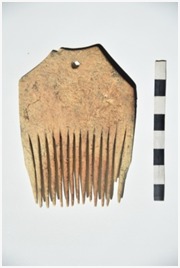
1. A bone comb is one of the elements of a girl’s adornment. The comb is multi-toothed with small, long teeth. The teeth start from the middle, length – 4.5 cm, width – 0.3 cm. The length of the comb is 9.5 cm, width – 7 cm. The comb is trapezoidal in shape, with a hole at the top. Number of teeth – 15. This item dates back to the 7th–8th centuries AD. It was discovered in 2016 during the excavation of mound No. 81.
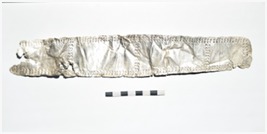
2. A forehead ornament made of a silver plate of rectangular shape with rounded edges and embossed patterns. Width – 5.7 cm, length – 31.5 cm. This item dates back to the 7th–8th centuries AD. It was discovered in 2016 during the excavation of mound No. 81.
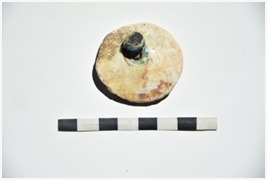
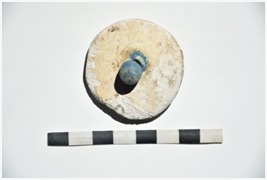
3. A round button of ivory color with a hole in the center. Diameter – 4 cm. The sides of the button are rounded. A metal insert of mushroom shape: cap diameter – 0.7 cm, stem length – 1.6 cm. The button is in excellent condition. This item dates back to the 7th–8th centuries AD. It was discovered in 2016 during the excavation of mound No. 81.
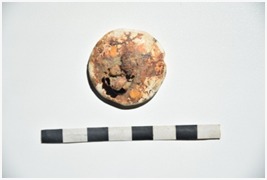
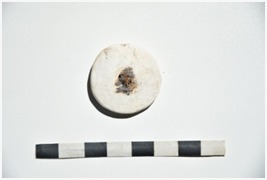
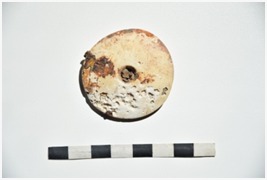
4. A round button. Diameter – 4.5 cm. There is a hole in the center containing a holder-like object with a round cap. Traces of corroded metal are visible on the surface. This item dates back to the 7th–8th centuries AD. It was discovered in 2016 during the excavation of mound No. 81.
5. A round white button with a hole in the center. The surface has a corroded metal insert. Diameter – 3.4 cm. This item dates back to the 7th–8th centuries AD. It was discovered in 2016 during the excavation of mound No. 81.
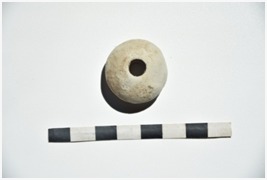
6. A gray spindle whorl, round, with a hemispherical top. There is a round hole in the center. Length and width – 3 cm; hole length and width – 0.7 cm. This item dates back to the 7th–8th centuries AD. It was discovered in 2016 during the excavation of mound No. 81.
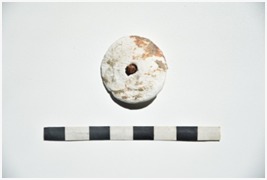
7. A round white button with a circular hole in the center. Diameter – 3 cm. This item dates back to the 7th–8th centuries AD. It was discovered in 2016 during the excavation of mound No. 81.
8. A white round button with an iron rod in the circular hole at the center. Diameter – 3 cm. This item dates back to the 7th–8th centuries AD. It was discovered in 2016 during the excavation of mound No. 81.
9. A white round button with an iron rod in the circular hole at the center. The reverse side has a protruding part on the surface. Diameter – 4.4 cm. This item dates back to the 7th–8th centuries AD. It was discovered in 2016 during the excavation of mound No. 81.
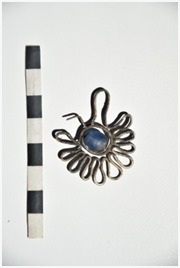
10. An earring in the shape of a flower with a rosette in the center, into which a blue stone is set. Made from a single piece of wire, flat in cross-section, ending with a loop for hanging. Length – 4 cm. This item dates back to the 7th–8th centuries AD. It was discovered in 2016 during the excavation of mound No. 81.
https://berel-museum.kz/en/kontakty/123-funds/358-the-collection.html#sigProIdbc53e8883b